Malden Wood Flooring brings more than 20 years of hands-on work to wood-flooring in Winchester, and this page covers the part of that work that begins one level down. Basement family rooms, lower-level playrooms and ground floors that have taken on water all ask the same question before we quote anything: is the space dry enough to hold wood, and will it stay that way?
When a floor has already been wet, we treat it as a tracing job before it becomes a flooring job. The source gets found, the room gets dried, and a moisture meter tells us when the boards and subfloor have come back down. Every affected room is photographed and measured so the adjuster sees the damage room by room rather than as one lump figure.
The rest of the house gets the same care. We check an engineered floor’s wear layer before promising a sanding, price stairs by the tread and riser, confirm the build year and any painted surfaces before a sander runs, and pick finishes that sit within the Massachusetts VOC limits for wood coatings.
Wood Floors and Winchester’s Groundwater
Two Ways Water Reaches a Lower Floor
The Town of Winchester names the Aberjona River and its tributary, Horn Pond Brook, as the most significant source of surface water flooding in town. That is the flooding most people picture: water over the banks, into streets, and through doors. The town also describes street drainage failures as a separate kind of flooding.
The third kind is the one that matters most to a basement floor. In the town’s own words, any property in Winchester is susceptible to basement flooding from rising groundwater or underground springs. That is not limited to lots beside the river, and it is why we ask about water history on every lower-level job here, wherever the house sits.
Why River Work Does Not Dry a Basement
The town is plain about this point: drainage improvements on the Aberjona will not resolve groundwater basement flooding. When groundwater rises above a basement floor, hydrostatic pressure can push water through cracks in the foundation, and a wider river channel does nothing to change that pressure under a house.
For groundwater, the town recommends sump pumps and perimeter drains. We do not install either, but we want to know whether a house has them, whether the sump pump has run hard in recent storms, and whether the basement has stayed dry since. Those answers decide what kind of floor, if any, belongs on that level.
What Water Does to Wood Below Grade
Wood takes on moisture from whatever is under it. A floor laid over damp concrete tends to cup, with board edges rising higher than the centers, and a wetter one can buckle and lift off the subfloor entirely. Those failures often show up months after installation, well after the finish looks settled.
That is why a below-grade floor gets a different conversation than a bedroom upstairs. Industry installation guidance, including the NWFA Installation Guidelines, treats below-grade spaces as their own category, with testing and a vapor retarder plan settled before any wood arrives on site.
Species plays a part as well. White oak has a tighter cell structure than red oak and takes up water more slowly, while maple is hard but shows water stains sharply. None of them makes a wet basement safe for wood, so the choice of species always comes after the moisture question, never instead of it.
Looking for wood-flooring closer to Cambridge? See Wood-Flooring in Cambridge.
After the Aberjona Rises: Water-Damaged Floors
A Flood Record the Town Keeps
Winchester’s Local Flood Hazards page lists major floods in October 1996, June 1998, April 2004, May 2006 and March 2010. The March 2001 event, snowmelt on top of heavy rain, produced the highest streamflows ever measured at the local USGS station. In March 2010 the Aberjona overflowed its banks and flooded the town center.
The town’s Flood Mitigation Program puts the economic losses from that flooding above $25 million. Its state MEPA review concluded on April 2, 2010, the river channel was widened in 2012, and a railroad bridge culvert project near the Muraco School is under construction with a 2027 target. None of that work is aimed at groundwater under a basement floor.
Tracing and Drying Before Any Board Is Replaced
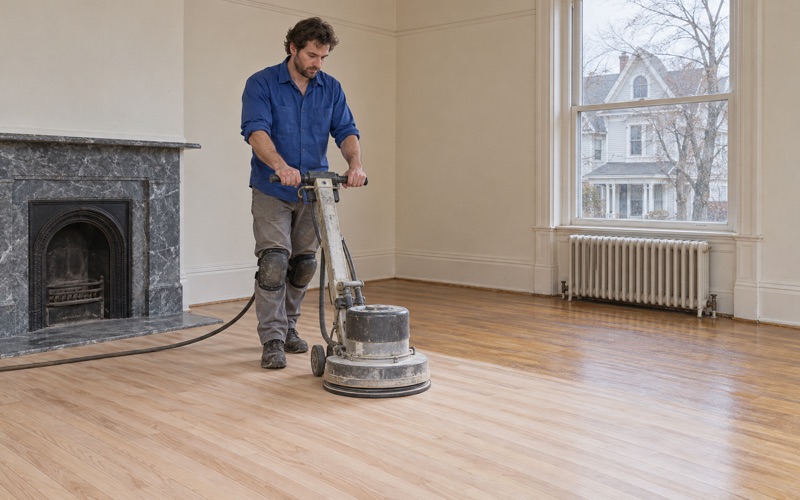
A wet floor usually looks worse than it is in the first week. Boards that have cupped from water below them often flatten again as they dry, and sanding a cupped floor too early cuts the raised edges down, so the boards crown once the moisture leaves. We take meter readings over several visits and wait for them to settle before deciding what stays.
Water from a flooded lower level is not the only source we trace. A leaking radiator, a failed supply line or an upstairs overflow can stain and lift boards on the level below. Dark water stains that have reached the wood fibers need board replacement, while lighter marks sometimes come out in a full sanding.
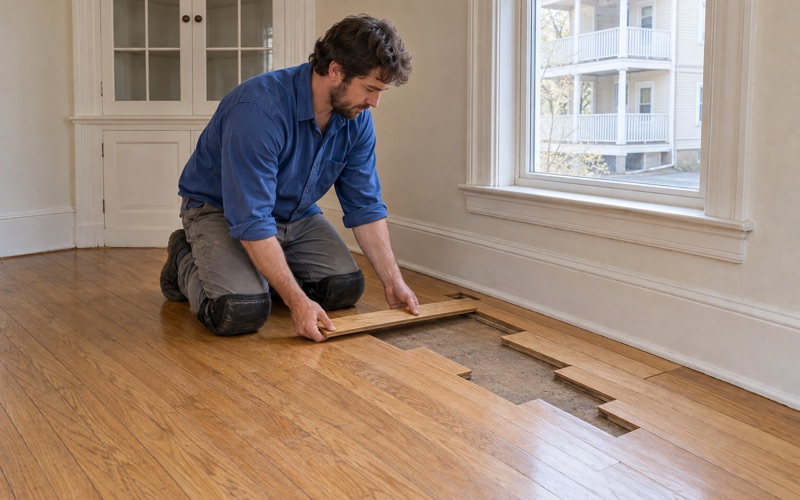
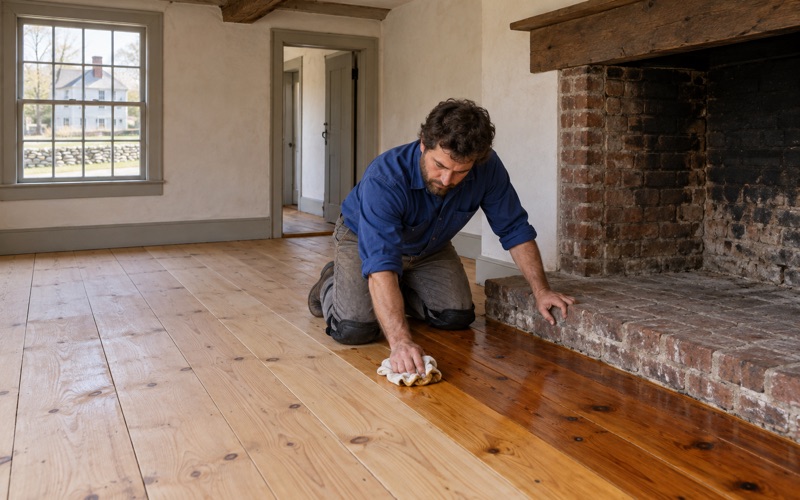
When boards do have to come out, we cut them back to sound wood and weave matching boards into the surrounding floor rather than patching a square. The repaired area then goes through the same grit sequence as the rest of the room, and on a stained floor we lay down stain samples first so the new wood and the old read as one surface.
Documenting Damage for the Adjuster
We record each affected room separately, with its square footage, the species and style of the floor, readings from the moisture meter, and photographs of cupping, buckling and staining. A room-by-room record gives an adjuster something to review instead of an estimate to take on trust.
What a policy pays for is between the homeowner and the carrier, and we do not predict it. Our part is an accurate description of the floor, the damage and the repair, written so the adjuster can see how each figure was reached.
Finished Basements and Lower Levels in Winchester
Choosing a Floor for a Lower Level
For a finished basement, an engineered floor is usually the first option we discuss. Its plywood core moves less with humidity than solid hardwood, and many products are rated for below-grade use. A prefinished engineered floor also skips the sanding dust and finish fumes of site-finished work in a closed lower level.
The wear layer decides how long that floor lasts. A thicker engineered wear layer can be sanded and refinished later, while a thin one may only allow a screen and recoat. We measure the wear layer on an existing engineered floor before promising a sanding, because sanding through it cannot be undone.
Subfloor, Underlayment and the Expansion Gap
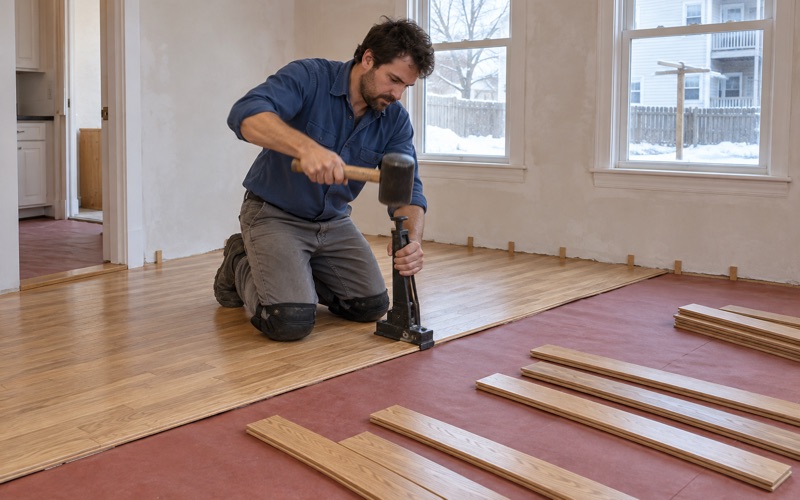
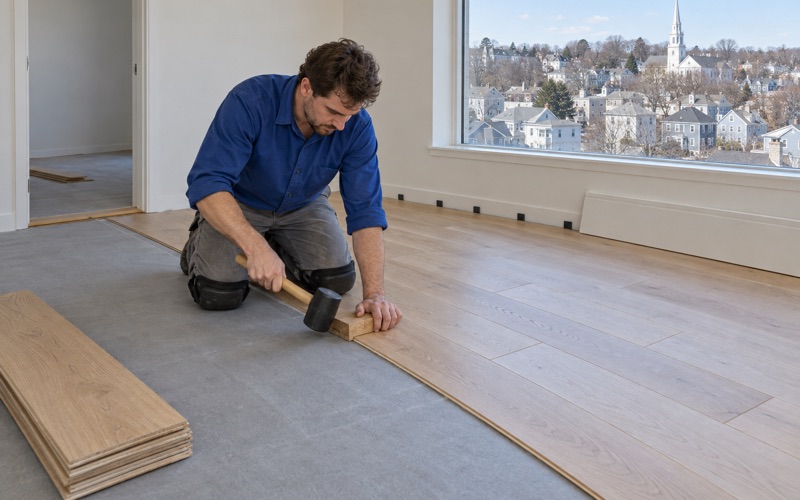
What sits under the wood matters as much as the wood itself. A lower-level floor needs a flat, dry subfloor, the right underlayment for the product, and a vapor retarder where the manufacturer calls for one. A floating floor over uneven concrete telegraphs every dip, and it will bounce underfoot.
Every wood floor also needs an expansion gap at the walls, hidden behind the baseboard and quarter round. Where the basement floor meets a tiled bath, a mechanical room or the bottom stair, we finish the edge with a reducer or threshold so the wood can still move without catching.
Lower-Level Stairs and Transitions
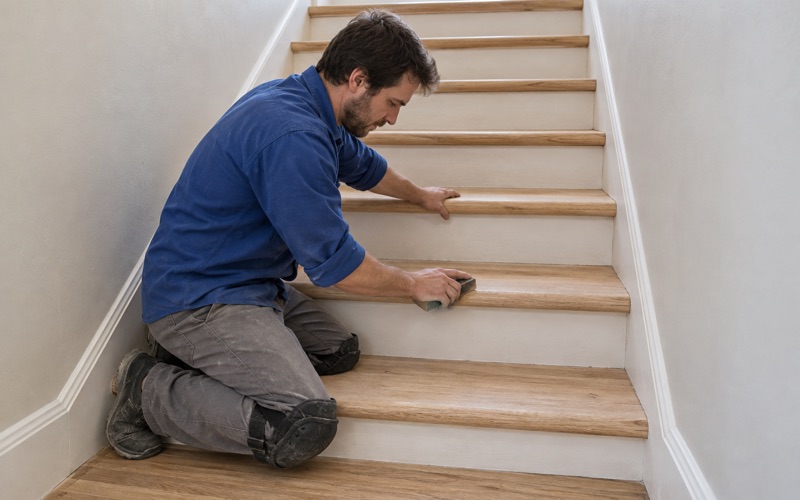
Basement stairs take heavy traffic and often get forgotten until the floor below is new. We quote stair treads, stair risers and stair nosing by the piece rather than folding them into a square-foot price, so you can see exactly what the staircase costs.
On older basement stairs, painted treads are common. We check the paint and the house’s build year before sanding, because Massachusetts has its own lead-safe renovation rules for homes built before 1978, and scraping or sanding old paint falls under them.
Checking Moisture and Planning a Floor Project in Winchester
Readings Before Refinishing or Installing
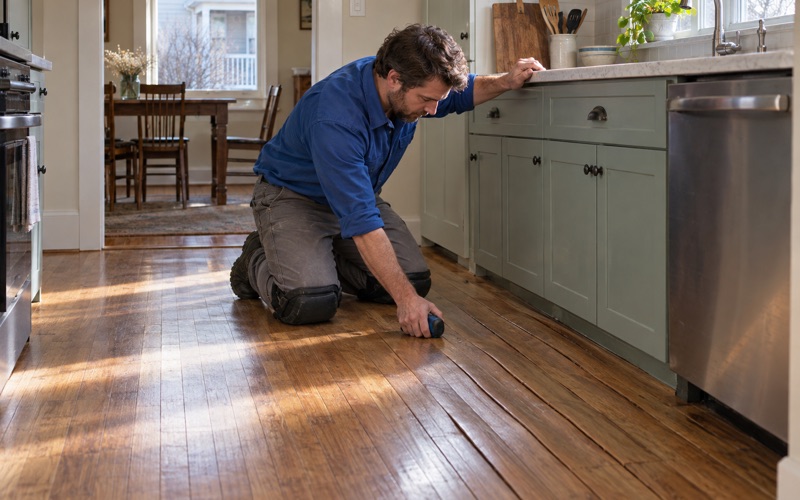
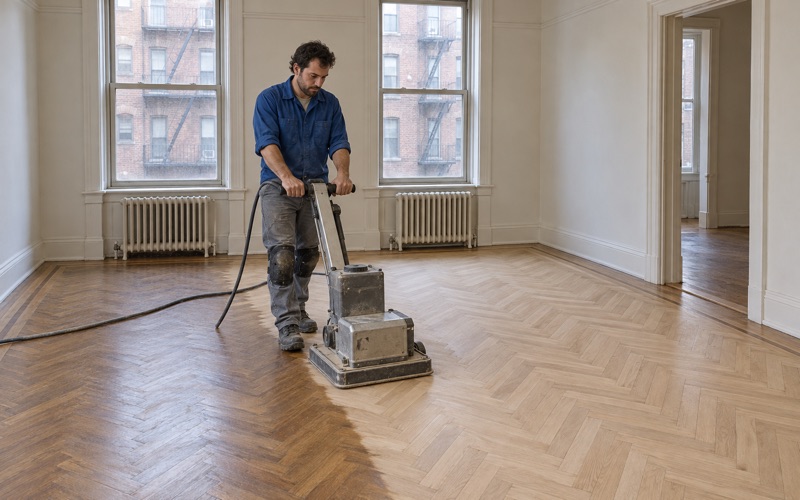
Before we refinish a floor on any level, we check it with a moisture meter, both in the field and near exterior walls, and compare the readings. Before we install, we check the subfloor and the new wood and let the boards reach acclimation with the room. These are our working practices on every job, not a town rule.
If the readings do not agree, we stop and find out why. A reading that climbs toward one wall can point to a foundation crack, a downspout discharging too close to the house, or a sump pump that is not keeping up, and none of those is fixed by a new floor.
Radiant heat under a lower-level floor adds its own step. The system has to be run and then brought down to a steady temperature before installation, and the flooring product has to be rated for use over it. We confirm both before we order material, since a floor that dries out fast over heating tubes tends to open up board gapping by midwinter.
Upstairs Floors in the Same House
Many lower-level jobs lead to a look at the floors above. Oak found under old carpet or linoleum is cleaned of carpet pad, staples, tack strip and adhesive before it is sanded. Old pine gets its board thickness checked first, because older boards have less wood left to sand.
For finishes, waterborne polyurethane and hardwax oil are both options that fit the Massachusetts VOC limits for wood coatings. Where radiators or pipes were removed, the holes they left are patched with matching boards woven into the floor, not filled with putty.
Scheduling Around the People Living There
Winchester is largely a town of owners, with 81.7 percent of occupied units owner-occupied, and many of them live in the house while the work happens. We sequence a job so the family keeps a working kitchen and bedrooms while one area is sanded and finished.
In an owner-occupied two-family, we schedule one floor at a time so the household on the other level keeps living there. A basement that has flooded before is planned around the season, too, with the lower level left until readings hold steady.
Winchester falls in the National Weather Service forecast zone MAZ014, Southeast Middlesex, and we watch that forecast when a lower-level job is on the calendar. Heavy rain or a fast snowmelt in the days before installation is a reason to take fresh readings and, if the numbers move, to push the start date rather than lay wood over a floor that is taking on water.
- 20+ Years on Wood Floors
- Free Written Estimates
- Stairs Priced Per Tread