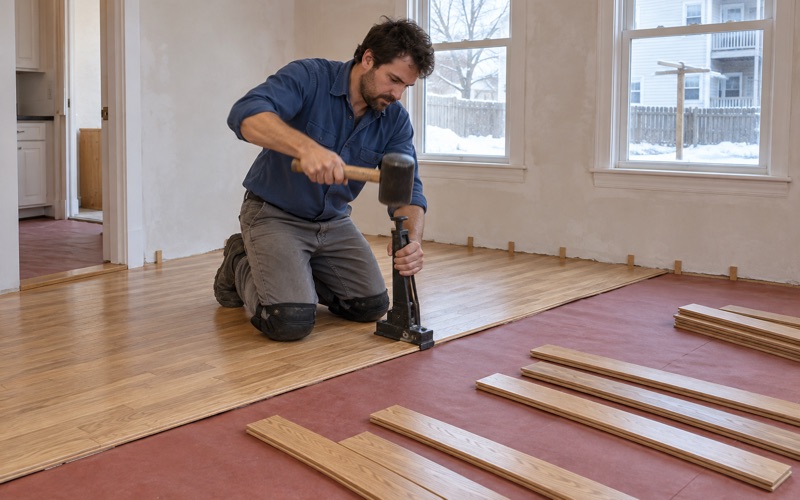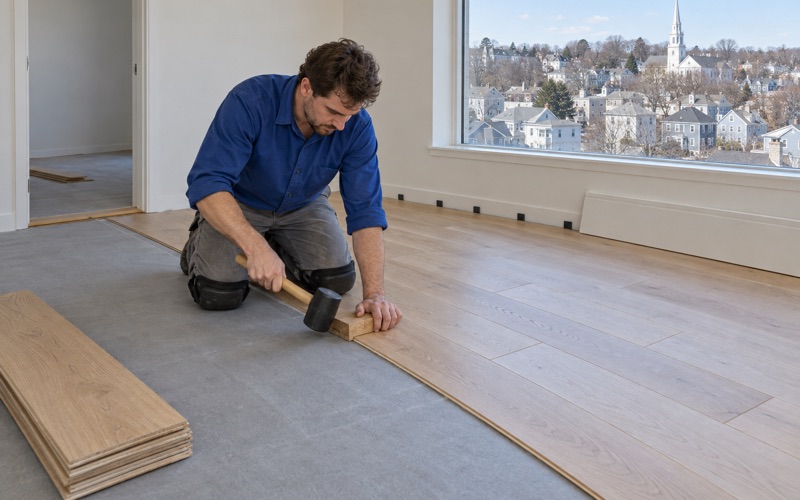
Malden Wood Flooring has spent more than 20 years on wood flooring in Wakefield and the towns around our Malden shop, and most of the floors we are called to here are older than the people who own them. We refinish, repair and install solid hardwood and engineered floors, and we treat an old floor as something with a limited amount of wood left in it rather than a surface to grind flat.
That changes the order of the work. Before a drum sander touches a room we look at the board count, the thickness above the tongue, the fasteners, any painted surfaces and the year the house was built. Those readings decide whether a room gets a full sanding, a screen and recoat, a set of weave-in repairs or a careful hand approach, and we explain the choice before we quote it.
What follows covers the houses this work usually happens in, what the town’s rules do and do not reach, and how we plan a floor project so the house stays livable while it is underway.
Floors in Wakefield’s Federal and Greek Revival Houses
Wakefield’s oldest housing is concentrated in a few places the National Register has already named. The town was incorporated in 1812 as South Reading and took the Wakefield name in 1868, and a good share of what stands from those decades still carries its original exterior character.
The Church-Lafayette Streets Historic District
The Church-Lafayette Streets Historic District was added to the National Register on July 6, 1989. It runs along Church Street between Common Street and North Avenue and along Lafayette Street between Common and Church Streets, and it is made up of late-18th- and early-19th-century houses in the Federal and Greek Revival styles.
The Lafayette Street houses in the district date to about 1834 and 1835. The listing describes their architecture and their exteriors; it says nothing about the rooms inside, so every floor we open in a house of this age is a question answered on site, board by board, rather than something we assume from the address.
The Hartshorne House and the oldest boards in town
The Hartshorne House at 41 Church Street dates to about 1681 and was remodeled in the Federal period of the late 18th and early 19th century. A house with that kind of history is a reminder that the floors in an old Wakefield home may have been relaid, patched or covered more than once.
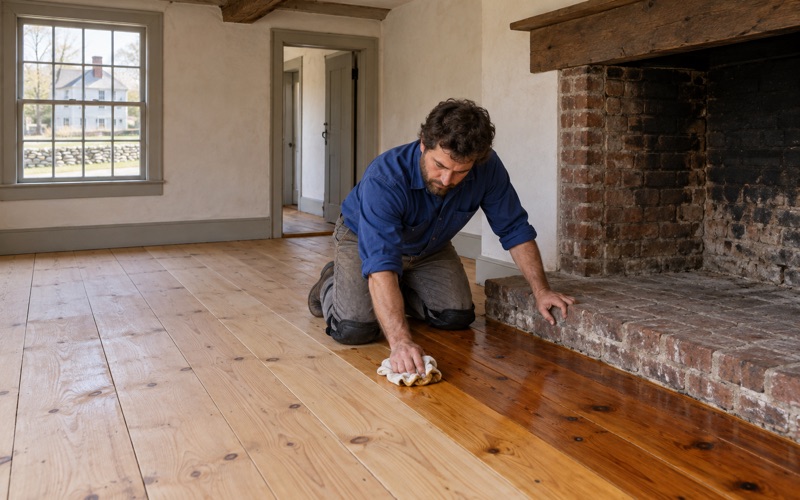
For us that means reading a floor before judging it. Cut nails, face nailing, boards of mixed widths and old repairs all tell us how the floor was built and how much sanding it can take. An old pine or early oak floor that has been sanded several times may have very little wood left above the nail heads.
Patching where heat and plumbing used to run
Houses of this age have often been through several heating systems. When a steam radiator or an old pipe run comes out, it leaves holes and discolored boards behind.
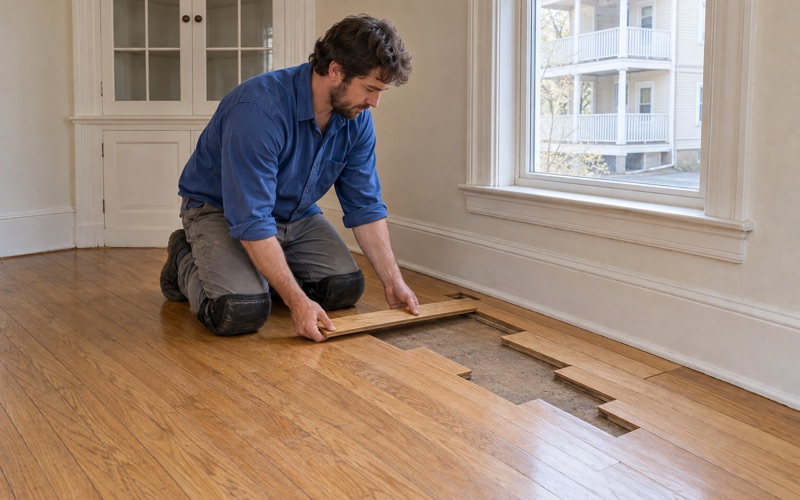
We patch those spots by weaving matching boards into the existing floor, staggering the joints so the repair follows the pattern of the room. We do not fill a radiator removal patch with putty or drop in a square plug, because both show once the finish goes down.
Looking for wood-flooring closer to Arlington? See Wood-Flooring in Arlington.
Italianate and Victorian Homes on Yale Avenue and Park Avenue
Two more National Register districts cover the town’s later 19th-century housing, and the houses in them are younger than Church Street but still old enough to need the same care with their floors.
Yale Avenue’s eight houses
The Yale Avenue Historic District was listed on July 6, 1989, and covers 16 to 25 Yale Avenue. It holds eight houses, all but one of which were developed in the 1860s and 1870s: five Italianate, one Second Empire, one Queen Anne and one Colonial Revival from about 1896.
As with Church Street, the district’s record describes architecture, not interiors. We make no assumption about what species or pattern lies under a rug in one of these houses. We find out by pulling a floor register or checking a closet edge and looking at the boards themselves.
Wakefield Park, an 1888 planned development
Wakefield Park was laid out in 1888 by J. S. Merrill as a planned development, later worked on with Charles Hanks in the 1890s, and was listed on the National Register on March 2, 1990. The district runs roughly along Park Avenue between Summit Avenue and Chestnut Street and takes in sixteen properties on 8 acres.
The house at 8 Park Avenue is recorded as a two-and-a-half-story wood-frame house mixing Colonial Revival, Craftsman and Queen Anne elements. Mixed styles like that often come with rooms remodeled at different times, so the floor in the front parlor and the one in a back bedroom may need different treatment.
What turns up under carpet and linoleum
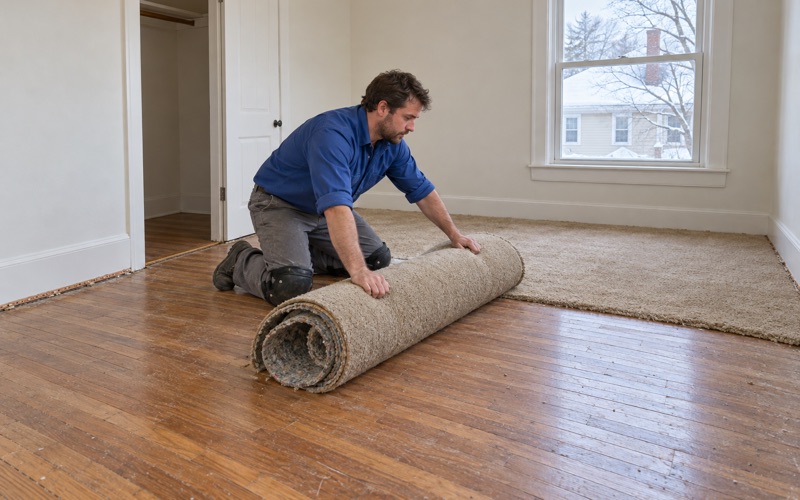
Many older houses had their wood covered at some point. When we lift carpet, carpet pad, tack strip or linoleum, we clean the floor of staples, pad residue and adhesive before any sanding starts, because debris left in the boards tears sandpaper and gouges the wood.
Black mastic under old tile or linoleum gets its own look before we decide how to remove it. Once a floor is clean we can judge the damage honestly: water stains, pet urine stains, traffic lanes and board gapping all show more clearly on bare wood.
What Wakefield’s Demolition Delay Covers, and What It Leaves Alone
Owners in listed houses often ask us whether refinishing a floor needs someone’s approval. The honest answer starts with what the town’s rule actually says.
Buildings the bylaw reaches
The Wakefield Historical Commission administers a Demolition Delay Bylaw under Town Code Chapter 126. It covers any building listed on the National Register of Historic Places or within an area listed on it, along with buildings on an inventory the commission provides to the Building Inspector.
The bylaw defines demolition as pulling down, destroying, removing or razing a building, or starting its total or substantial destruction. For a building found worthy of preservation, no demolition permit may be issued until at least six months after the application.
Interior floor work is the owner’s call
The bylaw is about demolition. Its text does not address interior work at all, so a floor refinish inside one of these houses is a decision the owner makes, and the exterior carries the listed history.
That does not make the floor disposable. We still treat an old floor as the last of its kind in the house, and we will tell you plainly when a repair makes more sense than a replacement. For any permit question about a project, the Town of Wakefield Building Department is the office to ask.
Lead-safe prep in older houses
Wakefield’s housing is old: 3,731 of the town’s 11,750 housing units, or 31.8 percent, were built in 1939 or earlier. Massachusetts runs its own lead-safe renovation rules for homes built before 1978, stricter in places than the federal program.
So we confirm the build year and check painted surfaces, such as painted borders, stair risers and baseboard edges, before sanding. Where paint is involved, the work plan changes before any dust is made, and HEPA vacuum cleanup is part of how we finish every sanded room.
Refinishing and Planning a Floor Project in Wakefield
Once we know what the floor is and what the house allows, the rest of the project comes down to careful sanding, the right finish and a schedule that fits how you live.
Sanding old floors without wasting them
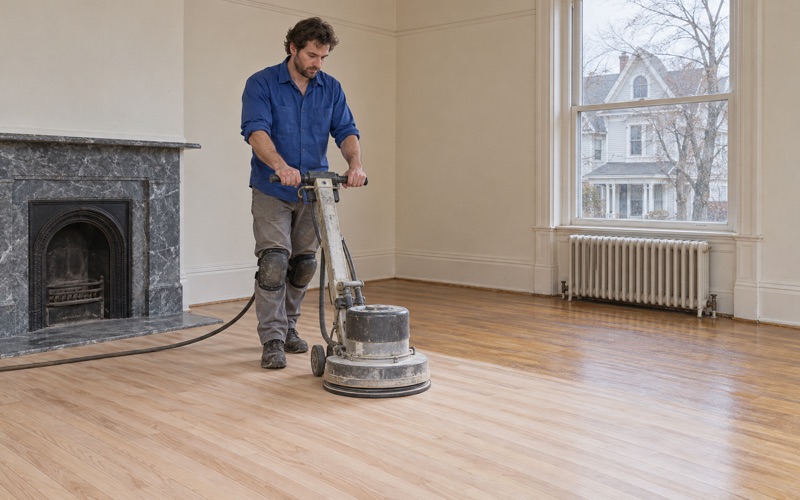
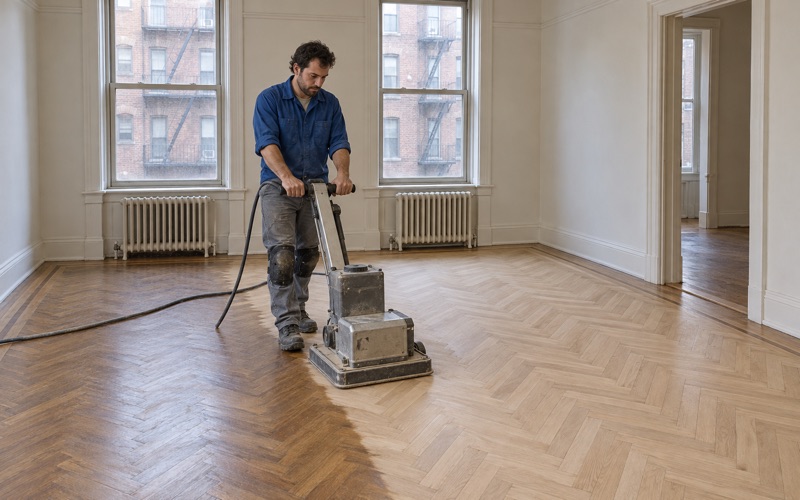
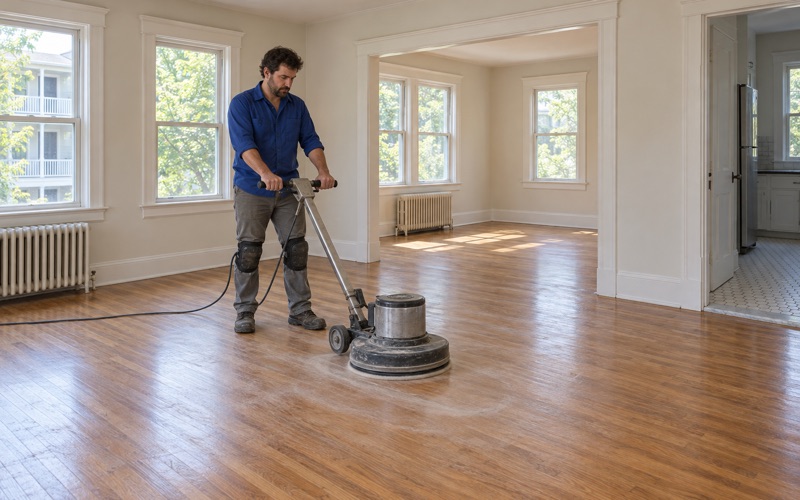
On an old floor we take the lightest grit sequence that will clear the damage. Cupping, crowning and old finish all affect the first cut, and a floor with thin boards may get an orbital sander pass rather than an aggressive drum sander pass.
If a floor only needs fresh protection, a screen and recoat with a buffer can extend its life without removing any wood. For engineered floors we measure the engineered wear layer before promising a sanding at all.
Stains, finishes and Massachusetts VOC limits
We lay down stain samples on the actual floor, often after water popping the grain, so you choose a color on your own boards rather than a showroom chip. Red oak, white oak and old pine each take stain differently.
The finishes we use fit the Massachusetts VOC limits for wood coatings, which are stricter than the federal ones. Waterborne polyurethane, oil-modified polyurethane and hardwax oil each have a place, and we talk through sheen level and wear before picking one.
Moisture, seasons and water damage
Wakefield sits in National Weather Service forecast zone MAZ014, Southeast Middlesex, and like the rest of the region it swings between humid summers and dry heated winters. Winter gaps that close again in summer are normal movement, not failure.
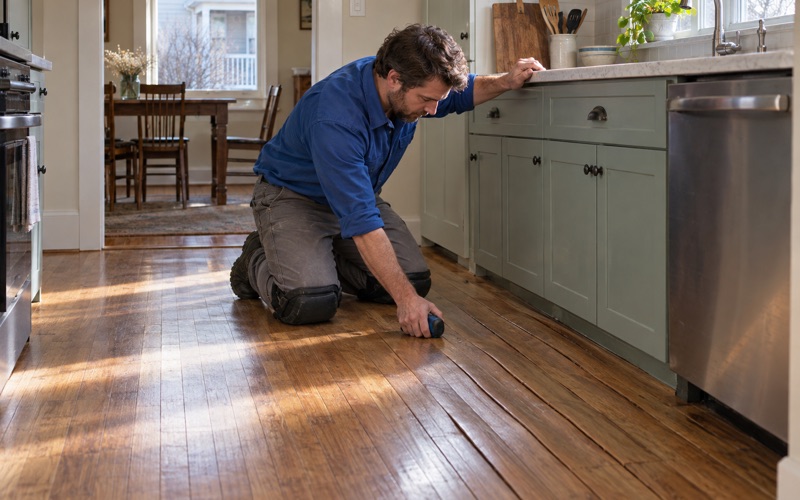
When water is the problem, from a leak upstairs, a radiator or a wet lower level, we trace it, dry it and read the area with a moisture meter before any board replacement. For an insurance claim we document the damage room by room for the adjuster.
Stairs, scheduling and getting started
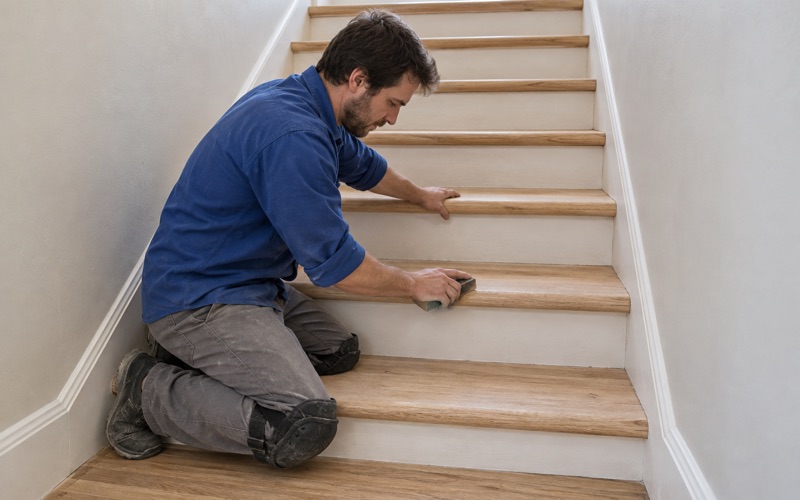
Stairs are priced by the tread and riser, with stair nosing, stair treads and stair risers counted individually rather than folded into a square-foot rate. That keeps the quote honest on a steep old staircase.
We schedule rooms in an order that keeps kitchens and bedrooms usable as long as possible. Tell us the rooms, the build year and what is on the floor now, and we will come look at the boards before we give you a number.
- 20+ Years on Wood Floors
- Free Written Estimates
- Stairs Priced Per Tread