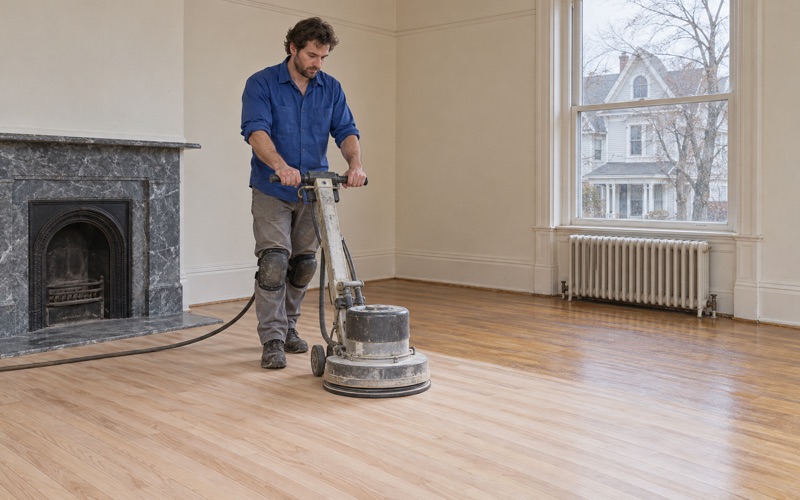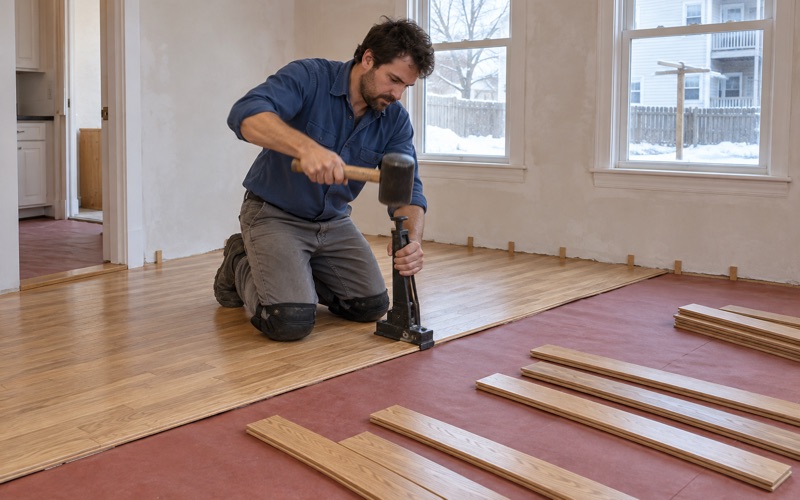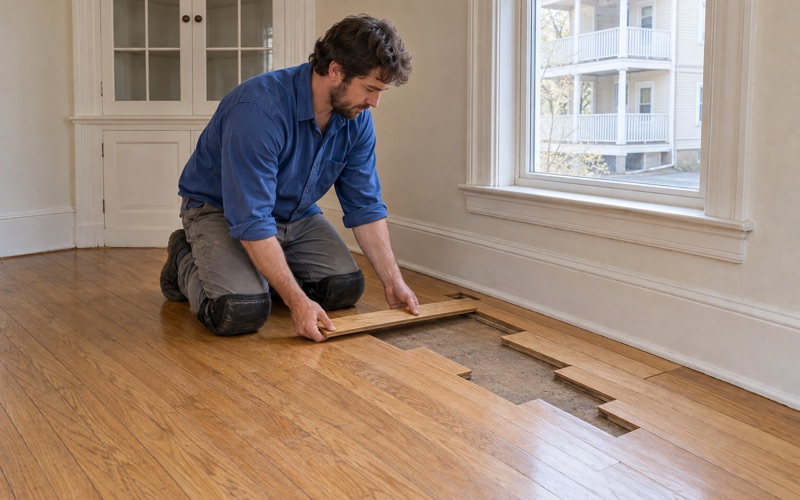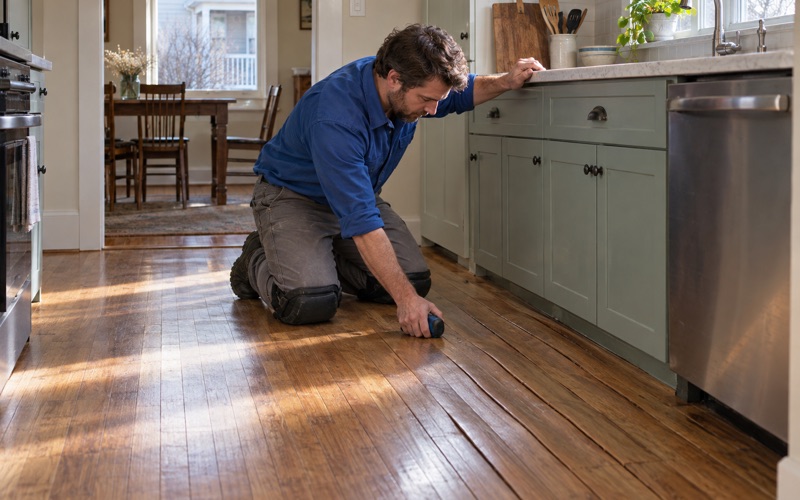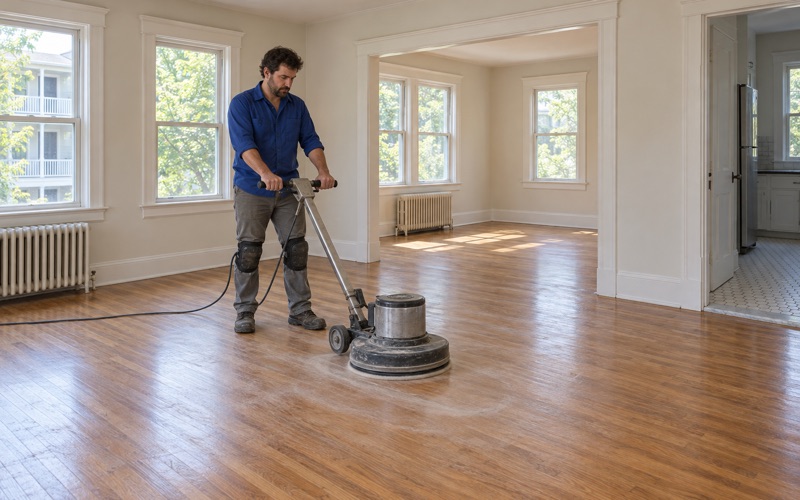
Malden Wood Flooring handles wood flooring in Amesbury for homeowners, landlords and condo owners, drawing on more than 20 years of sanding, repairing and installing hardwood. Most calls start with one of three needs: a worn floor that wants a full sand and finish, a damaged section that needs boards replaced, or a bare subfloor waiting for a new floor.
We begin every job by walking the rooms before we put a number on it. We look at how the boards were fastened, how much wood sits above the tongue, whether there is old finish or paint in the house, and what is hiding under carpet or linoleum. That walk decides whether a floor gets a full sanding, a screen and recoat, a repair or a replacement.
The finishes we apply are chosen to meet the Massachusetts VOC limits for wood coatings, which are stricter than the federal ones. The written scope that follows the walk-through spells out each part of the job, so you can see what the sanding, the repairs and the finish each involve before any work is scheduled.
Old Floors in Amesbury’s Mill and Carriage-Town Houses
Houses Built Around the Powow River Mills
Amesbury’s housing grew up around work. According to the Amesbury Carriage Museum, the Millyard held iron works, grist and saw mills and textile mills from about 1640, all powered by roughly 75 feet of drop in the Powow River over about an eighth of a mile. From the early 1850s the town turned to carriage making, and after 1900 its factories built upper-end auto bodies for Buick, Franklin, Stanley Steamer, Cadillac, Hudson and others.
That trade came to a rapid end with the Crash of 1929 and the Great Depression, but the houses built during those working decades remain a large part of the city. Of the 7,923 homes counted in the Census Bureau’s 2024 five-year survey, 2,825 were built in 1939 or earlier, which is 35.7 percent of Amesbury’s housing.
Checking How Much Floor Is Left
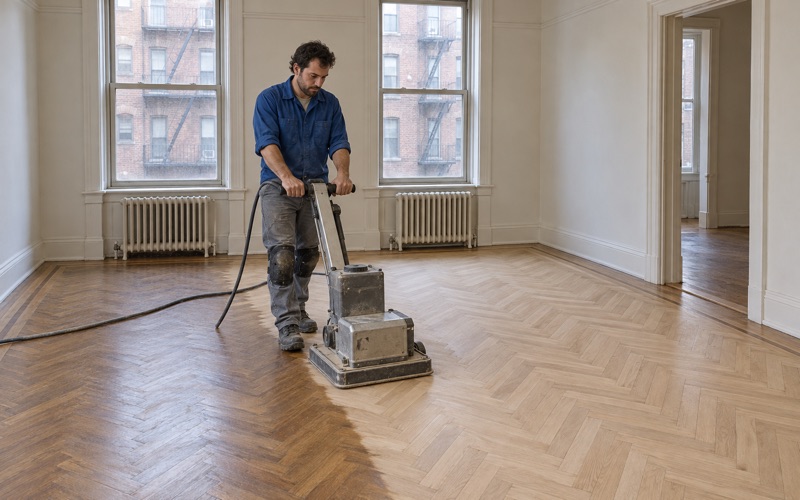
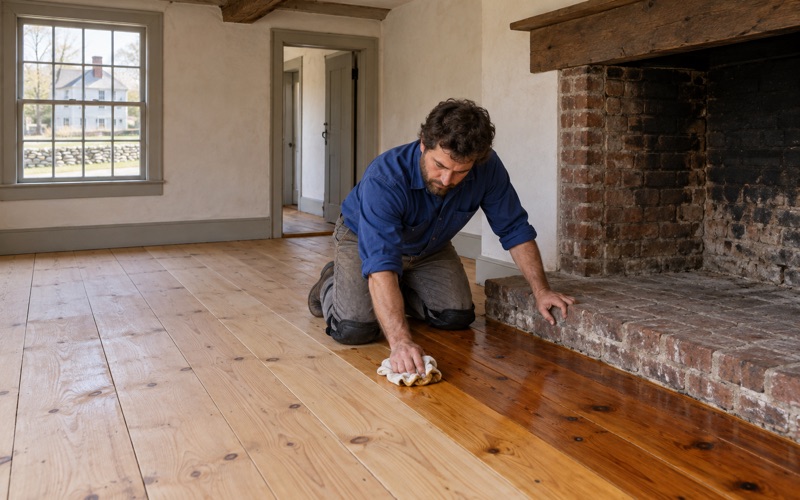
A floor that has been in a house for 90 years or more has often been sanded before, sometimes more than once. Old pine and early oak floors get the board count and thickness checked before we sand, because old boards have less wood left to take. A drum sander run too hard on a thin board can expose the tongue or the nail heads.
Older installations may be face nailed with cut nails rather than fastened with modern flooring cleats, and those nail heads have to be set below the surface before sanding. Where a board is too thin or split to sand, we replace it with a matching board rather than grinding the whole room down to its level.
Radiator Holes, Water Stains and Past Repairs
When a steam radiator or its pipes come out of an older house, the floor is left with holes and a patch of wood that never saw finish. We weave matching boards into those spots instead of filling them, so after sanding and finish the repair reads as part of the floor rather than a plug.
The same weave-in repair handles pet urine stains and water stains that have gone black and deep into the grain. Surface marks usually sand out, but dark stains that reach through the board call for board replacement, and we tell you which is which before the sander starts.
Looking for wood-flooring closer to Everett? See Wood-Flooring in Everett.
Wood Floors in Amesbury’s 1970s-1990s Condos and Townhouses
The Largest Building Wave Since 1940
The second big layer of Amesbury housing came much later. The 1970s added 1,242 homes, more than any decade since 1940, followed by 813 in the 1980s and 883 in the 1990s. Together those three decades supplied 37.1 percent of the city’s homes, a slightly larger share than the pre-1940 houses.
That wave added townhouses and mid-size apartment buildings, and the floors inside them are a different job from the carriage-era houses. Instead of thin old boards, we are more likely to find carpet over a plywood subfloor, a prefinished strip floor, or an engineered floor laid within the last few decades.
Townhouses and Attached Homes
The Census counts 835 one-unit attached homes in Amesbury, the townhouse type that shares a wall with its neighbor, and most of them are lived in by their owners. When one of these homes has an engineered floor, we measure the wear layer before promising a sanding. A thin veneer can take only a light pass or none at all, and then a screen and recoat or a replacement is the honest answer.
Solid hardwood in a townhouse is more forgiving. A red oak or white oak strip floor from the 1980s or 1990s generally has enough wood for a full sanding, and the decisions then come down to stain samples, sheen level and whether a waterborne polyurethane or an oil-modified polyurethane suits the household.
What Turns Up Under Carpet
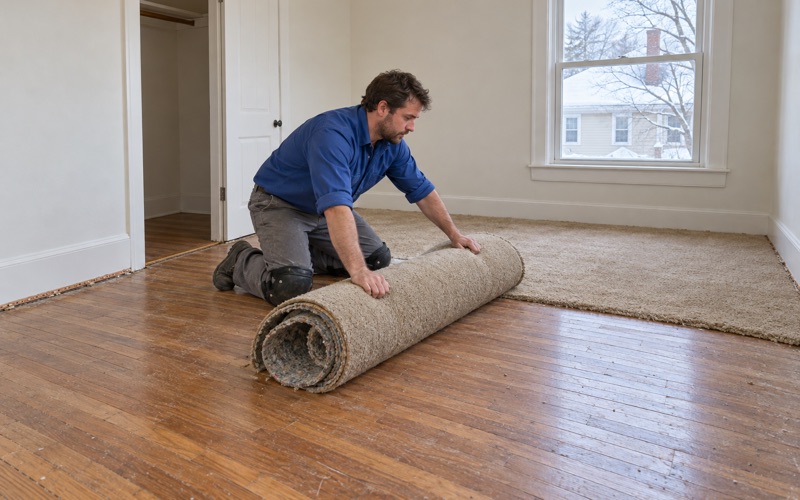
When a condo or townhouse floor has spent years under carpet, pulling it up sometimes reveals oak underneath. We clear the carpet pad, staples, tack strip and any adhesive before sanding, because a staple or a smear of glue left behind tears the sandpaper and gouges the board.
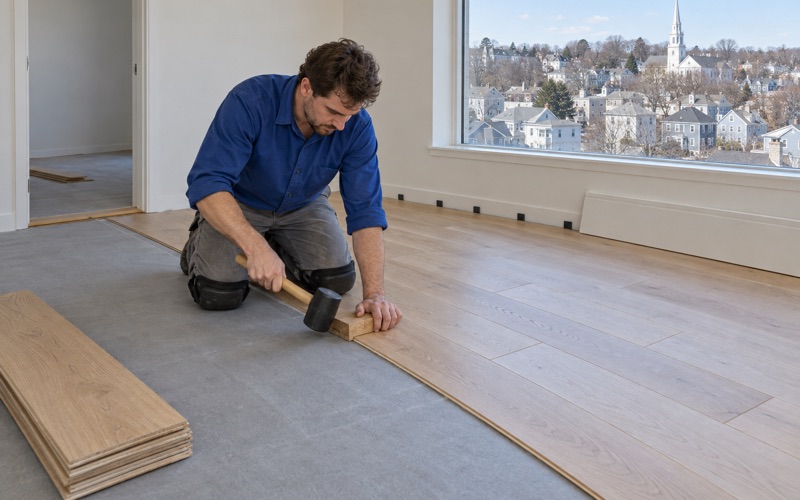
If the carpet was sitting on plywood rather than hardwood, the job becomes an installation. We check the subfloor for flatness and read it with a moisture meter, give the new boards time for acclimation, and leave the expansion gap at the walls that the NWFA Installation Guidelines call for, hidden behind baseboard or quarter round.
Floor Work in Amesbury Apartment Buildings
Where Amesbury’s Renters Live
Amesbury has 2,382 renter households, and about half of them live in buildings of ten to forty-nine units: 545 in ten-to-nineteen-unit buildings and 636 in twenty-to-forty-nine-unit buildings. The city counts 1,560 units in buildings of that size, a building type the 1970s-1990s wave added.
For a landlord or a management company, that means floor work usually happens one unit at a time, inside a building where the neighbors keep living their lives. We plan noise, dust and finish curing around shared hallways and the units above and below, and we keep the work inside the unit we were hired for.
Refinishing a Unit Between Tenants
The best time to refinish a rental floor is the vacant stretch between tenants, when furniture is out and nobody needs to walk the rooms. We work to that window, taking a worn floor through sanding, stain if you want one, and finish so the unit is ready to show again.
A screen and recoat is often enough when the finish is dull and scratched but has not worn through to bare wood. It buffs the existing finish and adds a fresh coat in far less time than a full sanding, which suits a short vacancy, while traffic lanes worn down to gray wood need the full sanding.
Water From the Unit Above
In a stacked building, a leak upstairs or a failed radiator valve can soak a floor that nobody below has touched. Water leaves cupping, where board edges rise above the centers, and in bad cases buckling off the subfloor. A cupped floor sanded flat before it dries can end up crowning once the moisture leaves.
We trace where the water came from, dry the floor and read it with a moisture meter before replacing a single board, because a floor replaced while still wet will move again. When an insurance claim is involved, we document the water-damaged floor room by room for the adjuster.
Planning a Floor Job Near the Millyard and Carriage Hill
Staying in the House During the Work
Most Amesbury homes are lived in by their owners: 5,204 of 7,586 occupied units, or 68.6 percent. For owners in a two-family house, we can schedule the floors one level at a time, so the household upstairs or downstairs stays in the house while the other floor is sanded and cures.
In a single-family house near Lake Gardner or on Carriage Hill, the same idea works room by room. We sequence the job so a kitchen or a bedroom stays usable, and we tell you when the finished floor can take socks, then furniture, then rugs.
Old Paint and the 1978 Line
Massachusetts runs its own lead-safe renovation rules for homes built before 1978, which takes in every pre-1940 house in Amesbury and the 1970s homes built before that year. We check the build year and any painted surfaces, including painted floors, baseboard and stair risers, before sanding starts.
When paint is present, the work is set up to contain dust and clean it with a HEPA vacuum rather than letting sanding dust travel through the house. A floor that was painted over entirely gets a closer look, and a written plan, before any sanding decision is made.
Demolition Review, Stairs and Finish Days
The Amesbury Historical Commission’s primary responsibility is reviewing demolition applications under Chapter 225 of the city’s code, which began as Article 40 of the 1990 bylaws. For questions about work beyond the floor, the Office of Community & Economic Development at 39 South Hunt Road is the place to ask.
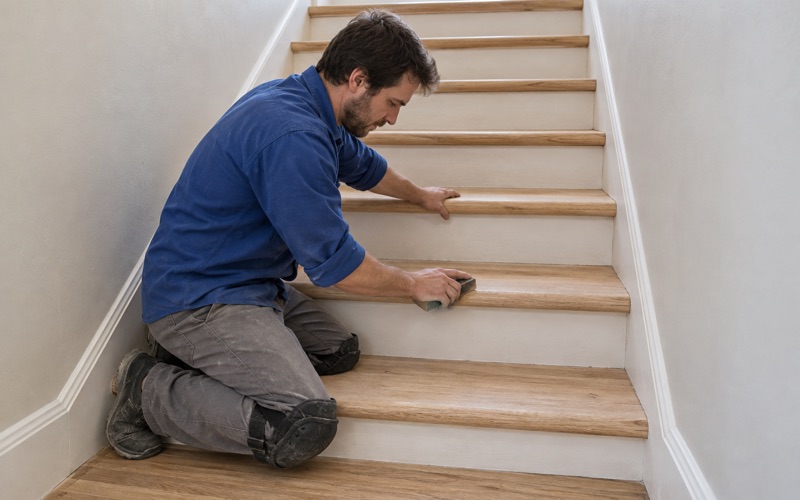
Stairs are quoted by the tread and riser rather than folded into a square-foot price, since stair treads and stair nosing take harder wear than any room. On finish days we watch the National Weather Service forecast for zone MAZ006, Western Essex, because temperature and humidity affect how long a coat takes to cure and whether windows can stay open for ventilation.
- 20+ Years on Wood Floors
- Free Written Estimates
- Stairs Priced Per Tread